
YouTube vs. Podcast for Your Business: Which Should You Start in 2026?
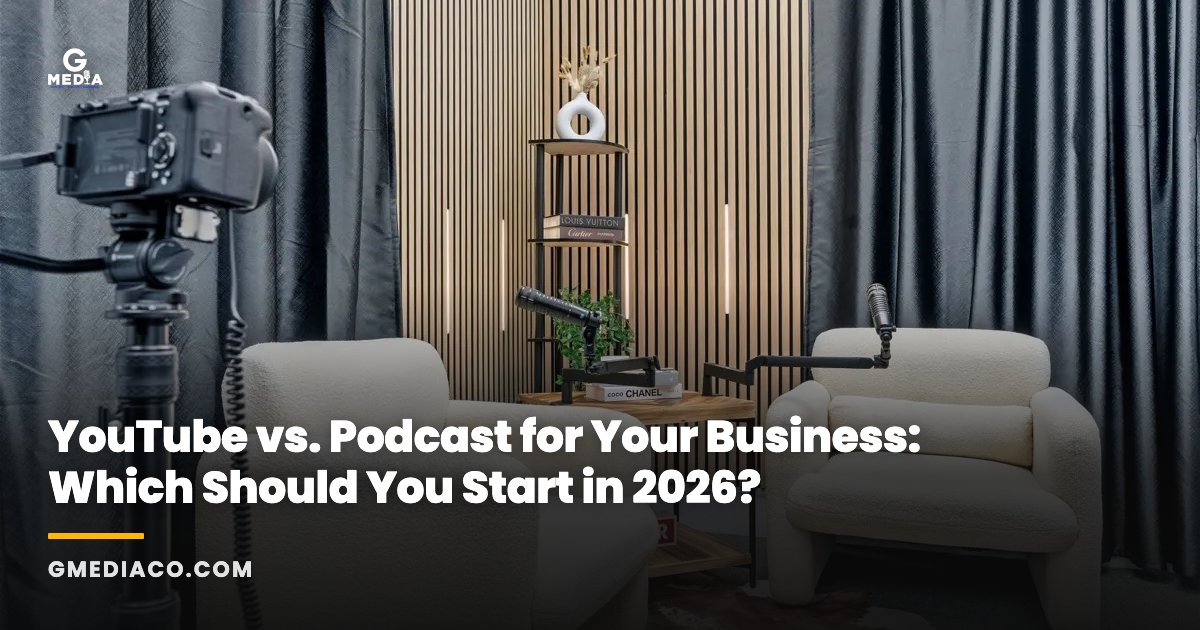
YouTube vs. podcast for business: which one should you actually start?
Start a video podcast. It is not a compromise answer, it is the cheapest way to own both channels with one calendar block. You sit down once, you leave with a long-form video, a long-form audio episode, and the raw material for short-form social.
The old version of this question assumed a podcast meant two microphones in a closet and YouTube meant a scripted shoot with a crew. That split stopped being real years ago. Spotify and YouTube both push video podcast episodes, and the same file that lives on your channel can be stripped to audio for the RSS feed with no extra production.
So the useful question is not which platform. It is which job you need done first, and how you build a recording habit you can actually sustain past episode four. Most businesses quit at episode four because the workflow was too heavy, not because the strategy was wrong.
What does YouTube do for a business that a podcast does not?
YouTube is a search engine with a recommendation engine bolted on. That means it can put you in front of people who have never heard of you, which an audio feed almost never does on its own. Someone types a question, your video answers it, and you get a viewer you did not already have.
What YouTube demands in return:
- A title and thumbnail that earn the click. This is the single biggest lever, and it has nothing to do with camera quality.
- Retention editing. Dead air, rambling setups, and slow openings get punished. The first thirty seconds decide the rest.
- Consistency of topic. The algorithm needs to learn who to show you to. Random subject matter keeps resetting that.
YouTube is where you go for reach and for evergreen answers to buyer questions. It is not where trust gets built quickly, because a viewer who watched four minutes of one video barely knows you.
What does an audio podcast do that YouTube does not?
Audio buys you attention nobody else is competing for: the commute, the gym, the dog walk, the drive between job sites. A listener may spend forty minutes with your voice in their ears with nothing else on screen. That kind of exposure builds familiarity faster than almost any other marketing you can buy.
The second advantage is underrated and it is the reason most B2B podcasts exist: the guest invite is the best cold outreach tool available. A partner, a referral source, or a dream client who ignores your email will often say yes to a well-produced interview. You get an hour of relationship building framed as a favor to you.
The weakness is discovery. Audio directories do not recommend aggressively, there is no thumbnail to click, and clips do not travel. Which is exactly the gap video fills. If you are weighing the full production side of this, our podcast production guide for Las Vegas walks through the format decisions in more detail.
Why is a video podcast the honest answer for most businesses?
Look at what one session actually produces when you record on camera in a room built for it. A ninety-minute block gets you a full long-form episode for YouTube, the audio version for Spotify and Apple, six to ten vertical clips for Reels, TikTok, and Shorts, still frames for your website, and a transcript you can turn into an email or a blog post.
Now compare that to running the two channels separately. A dedicated YouTube video and a dedicated audio episode means two prep cycles, two recording days, two edits, and two content calendars. Same output, roughly double the effort, and the first thing that gets dropped when the quarter gets busy.
The multiplier only works if the recording is clean at the source. Multi-camera angles give the editor cuts to work with. Isolated audio tracks per person mean one guest with a bad mic does not wreck the episode. Proper lighting means the clips look like a brand, not a webcam. This is the part people try to save money on and then quietly stop publishing.
Which should you prioritize if you can only do one thing well?
Record video regardless. But weight your distribution based on who you are trying to reach:
- Local service business (contractor, med spa, dentist, gym): lead with YouTube and short-form clips. Your buyer is searching, not subscribing. Answer the ten questions you get on every sales call.
- B2B or professional services (agency, law, finance, construction): lead with the interview format. The guest list is the strategy. Depth and relationships close your deals, not view counts.
- Personal brand or creator: lead with YouTube. Discovery is your whole business model, and clips are how you compound.
- Ecommerce or product: lead with short-form pulled from the recording. Long-form is your credibility layer, clips are your volume.
Whichever bucket you fall into, the clip pipeline is what keeps your other channels fed. If posting is already the bottleneck, the social media management guide covers how to turn one recording into a month of scheduled posts.
How do you launch a video podcast in the next 30 days?
A checklist that has survived contact with real businesses:
- Week 1, pick one narrow subject. Not business. Something like hiring and running crews in Las Vegas. Narrow is what makes you findable and what makes guests easy to book.
- Week 1, write ten episode titles as questions your customers ask out loud. If you cannot get to ten, the topic is too narrow. If you get to fifty, it is too broad.
- Week 2, book the room and batch. Schedule three recordings in one day, not three separate weeks. Batching is the only reason podcasts survive month three.
- Week 2, invite four guests with a one-paragraph email: the topic, the length, the room, and what they get back. Referral partners and past clients say yes most often.
- Week 3, lock your open. Cold open with the strongest thirty seconds of the conversation, then a five second intro. No long theme song, no throat clearing.
- Week 3, set the publishing rule. One long-form per week, three clips per episode, same day every week. Same day matters more than the day you pick.
- Week 4, publish three episodes at once so a new listener has something to binge, then hold the cadence for twelve weeks before you judge anything.
What does it cost, and how do you know it is working?
At our studio in Las Vegas, a session runs about ninety minutes and the first fully edited episode is $149. If your show needs to happen at a conference or trade show instead, mobile podcast production is $750 per hour with a three hour minimum, and we also cover event photography at $175 per hour and event videography at $250 per hour when you want the whole floor covered, not just the interviews.
For measurement, ignore vanity metrics for the first quarter and compute two numbers yourself:
- Cost per usable asset. Take everything you paid for the session and divide it by the number of pieces you actually published from it: one long video, one audio episode, every clip, every still. That denominator is the real reason to record on camera.
- Cost per qualified conversation. Add one line to your intake form or ask on every call: how did you hear about us? Count the people who name the show, then divide your quarterly spend by that count. Compare it to what a qualified lead costs you from ads today.
Track those two for ninety days and you will have a real answer instead of a feeling. If you would rather see the setup before committing, book a free studio tour and we will walk you through a live session. And if you are still comparing vendors, here is how to choose a video production company without getting talked into gear you do not need.
Want this handled for you? See how G Media does podcast studio in Las Vegas.
Frequently asked questions
Do I have to be on camera to start a podcast for my business?
No, but you give up most of the upside if you skip it. Audio only means no YouTube discovery, no vertical clips, and no visual proof of who you are. If being on camera is the blocker, start with guest interviews where you ask the questions and the guest carries the screen time.
Can I start a podcast if I have no audience at all?
Yes, and that describes almost every show at episode one. Early episodes are not for an audience, they are assets you send directly to prospects, partners, and referral sources. The searchable YouTube library and the guest relationships pay you back long before subscriber counts do.
How often should a business publish, and does weekly really matter?
Weekly is the sweet spot, but predictable beats frequent. One episode every two weeks that never misses outperforms weekly for a month followed by silence. Batch three or four recordings in a single studio day so a busy stretch does not break the streak.
Can I just record on my phone or laptop instead of using a studio?
You can, and for a solo show with no guests it is a reasonable place to test whether you will stick with it. The moment you add a guest, phone recording starts costing you: one bad mic, one echo, or one framing problem and the episode is unusable. Multi-camera angles and isolated audio tracks are what make an episode clippable.
Should I put the same episode on YouTube and Spotify, or make different versions?
Publish the same core episode to both, then treat the packaging differently. YouTube needs a title and thumbnail written for the click and a cold open that earns the first thirty seconds. The audio feed needs a clear show description and chapter markers, and it forgives a slower start.