
Trade Show Video Content in Las Vegas: Turning a Booth Into a Content Engine
Why do exhibitors fly home from Las Vegas with nothing recorded?
Look at what a booth actually costs you. Floor space, booth build, freight and drayage, flights, hotel at convention rates, and four or five people off their normal jobs for a week. Then look at what leaves the building: a badge scan export and a few phone photos someone took during a slow hour.
The reason is simple. Nobody was assigned to capture. Sales was assigned to sell, marketing was assigned to run the booth, and content was assumed to happen on its own. It never does. The people working the booth are the worst possible candidates to also shoot it, because the moment a real prospect walks up, the camera goes down.
This matters more in Las Vegas than almost anywhere. The convention calendar here puts your entire buyer list, your competitors, your channel partners, and the press in one hall for 72 hours. That density does not repeat until next year. Every conversation you have on that floor is content you are choosing not to record.
What does it mean to turn a booth into a content engine?
A content engine is not a highlight reel. It is a repeatable capture station inside your booth that produces finished assets on a schedule, hour by hour, for the length of the show.
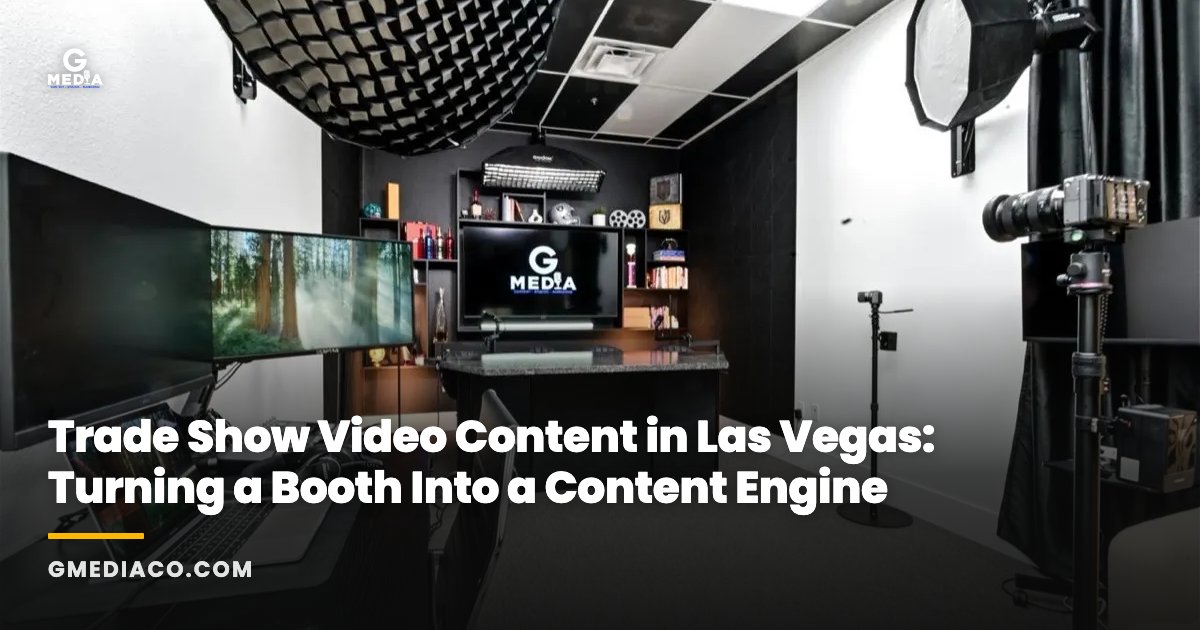
The physical setup is small on purpose: two chairs, two cameras, close-mic'd audio, one soft light source, and a backdrop that reads as your brand on a phone screen. It fits in roughly a 10x10 corner or a side pocket of a larger island booth. It should not eat the demo area.
What runs through it is the valuable part:
- Customer conversations. Twenty minutes with a client who already loves you, recorded while they are standing in front of you and in a good mood.
- Partner and vendor swaps. You interview them, they interview you, both companies post it. Free distribution into someone else's audience.
- Your own experts. Product lead explains the thing everyone at the booth kept asking about. That question is your next quarter of content.
- Floor texture. B-roll of the booth busy, hands on product, the walk-up, the aisle. This is what makes the edited pieces feel like an event instead of a webcam.
One 20-minute conversation reasonably yields a long-form episode, a short YouTube cut, and a handful of vertical clips. Multiply that by six or eight conversations a day.
How does a mobile podcast setup actually work on a convention floor?
Audio is where most on-site attempts fall apart. A convention hall is a giant reflective box with a PA, forklifts, and a neighboring booth running a demo loop at volume. Room mics and camera-top mics will capture all of it. The fix is close-mic'd audio, one mic per person, positioned inches from the mouth, plus recording every source separately so a noisy channel can be fixed instead of thrown away.
The logistics side is Las Vegas-specific and worth planning three weeks out. You need to order power to the booth in advance, not the morning of. You need to know your load-in window and whether your venue requires union labor for setup. You need to know if you have hard walls or pipe and drape, because pipe and drape moves and shows up in every wide shot.
G Media runs mobile podcast production at conventions at $750 per hour with a three-hour minimum, which covers the rig, the operator, and the capture. Booking in blocks is deliberate. A three-hour block on the floor is enough for six to nine recorded conversations if someone schedules them. Standalone podcast production in Las Vegas works the same way in-studio, and many exhibitors do both: floor capture during the show, follow-up episodes in-studio after.
What should you capture across three days on the floor?
Run this as a schedule, not as a vibe. Assign one person to own it who is not working the booth.
- Three weeks out: Book the crew, order power, confirm load-in and booth layout. Decide where the two chairs go.
- Two weeks out: Email your top 15 customers and partners who are attending. Ask for 20 minutes at a specific time. Booked interviews beat hoping someone walks up.
- One week out: Write five questions you will ask everyone. Same five, every guest. Consistency is what makes the clips cut together later.
- Setup day: Shoot the empty booth clean, before the aisles fill. You will want these wides for openers and thumbnails.
- Day 1: Run your booked interviews in the morning while everyone still has energy and clean audio. Capture the busy-floor b-roll at peak hours.
- Day 2: Record your own team answering the questions the floor kept asking. Grab walk-up guests in the gaps.
- Day 3: Teardown-day interviews are usually your most candid. Also shoot the reaction and recap piece with your own leadership before anyone flies out.
- Every night: Back up the cards to two drives. Every show has a card failure story.
If you also need stills and general floor coverage rather than interviews, event photography runs $175 per hour and event videography $250 per hour, which is a reasonable add for keynote sessions, booth activations, and after-hours dinners.
How do you know the video budget paid for itself?
Do not guess at this, and do not trust anyone quoting you industry averages. Compute your own two numbers.
Cost per finished asset. Take what you spent on capture and editing, divide by the number of publishable pieces you actually received. A three-hour block that yields eight conversations, eight long cuts, and thirty short clips is a very different number than the same block that yields one sizzle reel. Ask any production company how many finished deliverables come out, not just how many hours go in.
Cost per booth-hour. Add your floor space, build, freight, travel, and staff time, then divide by the hours the hall is actually open. Most exhibitors find this number is uncomfortably large. Compare the content line item against it. Recording the show is almost always a small fraction of what it cost you to be there.
Then judge the output on where it goes afterward. Content that sits in a folder is a cost. Content on a posting calendar is social media management with an unusual advantage: it was shot at the one moment your entire market was in the room.
How do you stretch three days into three months of content?
The show ends and most companies post a recap video eleven days later. That is the whole program. Instead, treat the floor footage as raw supply and meter it out.
Publish one long-form conversation per week for the next eight to ten weeks. Between them, drop the vertical clips, one strong idea each, captioned, no intro. Pull the recurring question your booth staff heard forty times and build a short explainer around it, because if forty people asked it in person, a lot more people are typing it into a search box.
Tag every guest and every partner company when you post. That is the distribution multiplier that on-site capture gives you and studio content does not. You are not just publishing to your audience, you are publishing into theirs, with them featured in it.
Keep the momentum in-studio between shows. A recurring episode in a Las Vegas multi-camera podcast studio keeps the same guests, the same format, and the same audience active in the eleven months you are not on a convention floor. First fully edited episode is $149, sessions run about 90 minutes.
How do you pick a crew for a Las Vegas trade show?
Ask about the floor specifically. Convention work is not the same as a corporate shoot in a conference room, and a crew that has never dealt with hall noise, drayage, or a 6 a.m. load-in will learn it on your dime.
- Do they mic every speaker individually and record isolated tracks? If the answer is a camera-mounted mic, keep looking.
- Are they local? A Las Vegas crew does not need flights, hotels, or per diem billed back to you, and they already know the venues.
- What are the actual deliverables and the turnaround? Get counts and dates in writing. Some clips should be in your hands during the show, not after it.
- Who runs the interviews? Someone has to keep guests talking and ask a real follow-up. That is a different skill than operating a camera.
If you are still comparing vendors, our guide on how to choose a video production company in Las Vegas walks through the questions that separate a real production partner from a person with a camera. And if you want to see the rig before you trust it on a show floor, book a free studio tour at our space on S Durango Dr, or call (702) 499-5111 to talk through your show dates.
Exhibiting in Las Vegas? See how G Media handles trade show video production in Las Vegas, or put a podcast booth on your show floor.
Frequently asked questions
How far in advance should we book on-site video for a Las Vegas convention?
Three to four weeks is comfortable, and earlier during peak convention weeks when crews book out. The lead time is less about the camera and more about ordering booth power, confirming your load-in window, and giving your team time to schedule guests. Booking a week out is possible but you will be capturing walk-ups instead of your top accounts.
Do we need to reserve extra booth space for an interview setup?
Usually no. A two-chair setup fits in roughly a 10x10 area or a side pocket of a larger island booth, and it should sit off the main demo path so it does not block traffic. If you have a 10x10 total, the setup can run in short scheduled bursts rather than all day, or move to a quieter meeting room nearby.
Can we interview attendees who are not our customers?
Yes, and it is often the best content you get. Analysts, adjacent vendors, and attendees reacting to what they saw on the floor give you third-party voices your own marketing cannot produce. Get a simple written release from anyone appearing on camera before you publish.
What is the difference between hiring event videography and a mobile podcast rig?
Event videography covers what happens: booth activity, keynotes, activations, the general look of the show, billed at $250 per hour. A mobile podcast rig produces recorded conversations with proper multi-mic audio and multiple camera angles, billed at $750 per hour with a three-hour minimum. Coverage gives you a recap; conversations give you months of publishable episodes and clips.
We are flying in from out of state. Do you handle everything on the ground?
That is the normal arrangement. Being local to Las Vegas means no travel or lodging billed back to you, and we handle the gear, load-in, and on-floor setup so your team can work the booth. Send us your booth number, hall, and show dates and we will build the capture schedule around them.