Speaking or Exhibiting at AWS re:Invent 2026? A Las Vegas Content Capture Plan
What should AWS re:Invent 2026 exhibitors plan before the event?
AWS re:Invent 2026 runs November 30 to December 4, 2026, across Caesars Forum, Caesars Palace, Encore, MGM Grand, The Venetian and Wynn. The audience is cloud and AI developers, engineers, IT leaders and business decision-makers. That mix matters, because each group wants a different kind of proof from you.
Start with the question every exhibitor skips: what will you be glad you recorded in January? Developers want to see the product working. Decision-makers want a customer saying why it mattered. Write down the three or four assets that serve those two groups, and plan backward from them.
- Name one owner for content on site. If everyone is responsible, no one is.
- Pick your talking points early so interviews and demos stay on message.
- Book people, not just gear. Ask customers and partners now whether they will sit for a short interview.
With the dates this close, scheduling is the real bottleneck. Lock the people and the time slots first, then worry about the equipment.
Which booth and session moments are actually worth filming?
Filming everything produces hours of footage nobody watches. Film the moments that carry an argument.
- Booth demos. Capture a clean, repeatable demo from the screen and from the presenter. Record it more than once, because the first take is rarely the best.
- Speaker clips. Mark the two or three sentences in a talk that someone would quote. Those become short clips. The full session rarely does.
- Customer interviews. A customer explaining a problem in their own words beats any slogan you write.
- Atmosphere. A few wide shots of your booth and the crowd give editors cutaways and give social posts a sense of place.
If you want a team that handles this regularly, our trade show video production in Las Vegas page explains how we approach booth and floor coverage.
How do you record customer interviews on a crowded show floor?
Noise is the enemy. A show floor can hide a great answer under a loud neighbor, so choose your interview spot as carefully as your questions. A corner of your booth, a quiet meeting room or a space with a solid backdrop all beat standing in an aisle.
Keep interviews short and structured. Ask three or four open questions: what problem they had, what changed, what surprised them, and what they would tell a peer. Get the subject's permission on camera and confirm how you may use the footage before you start.
For teams that want a recorded-conversation format right at the event, mobile podcast production at conventions brings the studio setup to you. It is priced at $750 per hour with a three-hour minimum, so it pays to arrive with guests already lined up and a schedule in hand.
For still coverage, event photography is $175 per hour and videography is $250 per hour. Those are useful when you need headshots of speakers, booth moments and a camera operator who knows how to stay out of the way.
Why record a podcast-style session at a studio off the Strip?
Conference weeks are loud, rushed and full of interruptions. A guest who has just walked off stage often has more to say than a booth interview allows. A studio gives them a chance to say it.
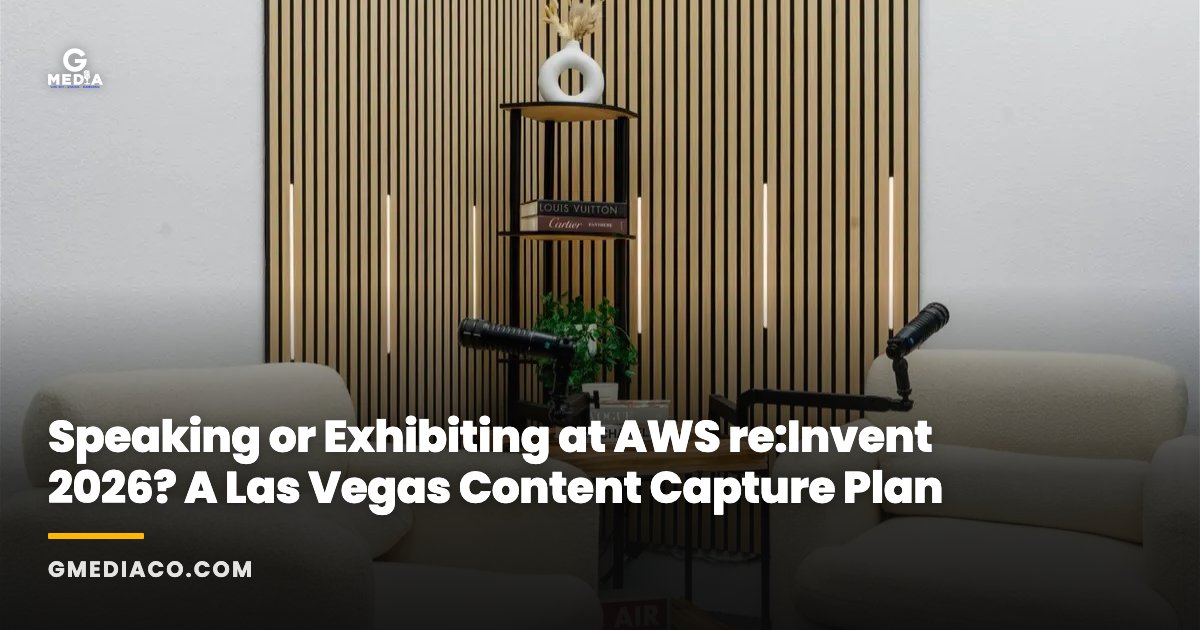
A multi-camera setup in a quiet room produces audio and video that hold up for months. You get a longer, more relaxed conversation, which edits into a full episode, short clips and quotes. Our Las Vegas podcast studio sits off the Strip, so a guest can step away from the show for a session of about 90 minutes.
If you have never produced an episode, the first fully edited episode is $149. That is a low-risk way to test the format with a customer or a speaker before you commit to a series.
Plan these sessions as invitations, not obligations. Offer two or three time windows and make it easy to say yes.
What is the on-site content capture checklist?
Use this as a working list. For a longer version, see our convention content capture checklist.
- Before you travel: confirm a content owner, a shot list and a list of interview guests with confirmed times.
- Permissions: collect release forms for customers, speakers and anyone prominent on camera.
- Booth rules: check what your venue and exhibitor guidelines allow for filming and equipment before you plan angles.
- Demo script: write a short, repeatable demo and rehearse it so the recording is clean.
- Audio first: test microphones in the actual space. Bad audio ruins good footage.
- Interview questions: prepare three or four per guest and keep them open-ended.
- Speaker moments: note the timestamps of quotable lines as they happen.
- File handling: back up every card at the end of each day and label folders by date and subject.
- Studio session: book the recording slot and send guests the address and timing in advance.
How do you turn one week of footage into weeks of content?
The work after the event decides whether the investment pays off. Sort the footage by purpose before anyone starts editing: what is a clip, what is a case study, what is a full episode, and what is just background.
One interview can become several pieces. Pull a short quote for a social post, a longer clip for your site, a transcript excerpt for a blog or newsletter, and the full recording for an episode. A single speaker session can yield a few different angles in the same way.
Spread the releases out. Post the strongest customer story first, then follow with demo clips, then reflections and lessons. Tag the people involved and give them a reason to share it.
If your team lacks the time to keep a calendar like this running, a social media management service in Las Vegas can handle scheduling and posting, so the footage does not sit in a folder. Build the plan before you leave for the event, and the follow-up gets much easier.
Frequently asked questions
Do I need a production company to capture content at re:Invent?
No, but it helps if no one on your team can spare the time to shoot and manage audio while also working the booth. A small team can capture phone clips and notes. A crew is useful when you want polished interviews, multiple camera angles or recorded conversations.
What is the best type of content for developers versus business buyers?
Developers tend to respond to clear, working demos and technical walkthroughs. Business decision-makers usually respond to customer stories that explain a problem and its outcome. Capture both, and label them clearly so you can send each audience the right clip.
Can I record a podcast episode during a conference week?
Yes. You can record on site with a mobile setup, or step away to a studio for a quieter session of about 90 minutes. At G Media, the first fully edited studio episode is $149, and mobile convention production is $750 per hour with a three-hour minimum.
Do I need permission to film people at my booth?
Get written consent from anyone you plan to feature, including customers, partners and speakers. Also check the exhibitor guidelines for your venue before you set up equipment or lighting. When in doubt, ask the show organizers directly.
How should I plan the content calendar after the event?
Sort footage into clips, case studies and long-form pieces, then schedule them over several weeks rather than posting everything at once. Lead with your strongest customer story. Reserve the rest for follow-up posts, newsletters and your website.